Posts

ABANYALA BA KAKAMEGA: The Concept of Curses

Image
Among the Abanyala, a curse is called esilaamo . Esilaamo  is viewed as a 'skillfully' expressed ritualistic ill wish which leads to consequences. The Abanyala's phobia for esilaamo still remain indispensable. It is believed that esilaamo affects the target person or the person's children even if that person doe not believe in it. A curse is meant to threaten in order to prevent ills in society and not to harm. A curse can only be potent towards the target person if three conditions are fulfilled: The one cursing has the cursing advantage over the other: special social or blood connection with the one being cursed. Curses can be done either by an individual or by a social group as a ritual.  The one being cursed is in the wrong and has had prolonged or serious provocation- situaton igniting a curse is not out of jealous, malice or uncalled for emotions. The one being cursed took no precautions to prevent the curse- after knowing the curse was being brooded. ...
ABANYALA BA KAKAMEGA: List of Taboos

Taboos among Abanyala existed as  emisiro  that are believed to lead consequences such oluswa  (self inflicted curse). Some aspects of taboos had a hidden reason behind them while others have remained a mystery. Most cultural activities have taboos invoked. 1. Taboos related to funerals To ensure some expected behaviour is achieved during funeral, the following are some of the taboo. A person coming back from a funeral is never beaten and should never beat anybody. That it invited death and suffering. A person from a funeral never visit an extremely sick person. That it lead to the death of the sick. Visiting could make you tell the sick about the death. This could affect the sick psychologically. A widow given responsibility to bury the dead had to visit her clan to be given chicken and flour.  A widow should not participate in house chores such as cooking before burial. That it made the dead person's spirit angered and caused more deaths. If a person dies ...

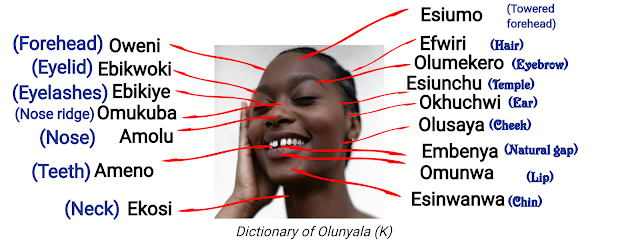
ABANYALA BA KAKAMEGA: Names of Human Body parts.

Image
1. PARTS ON THE HEAD a) External parts of the head. Amakale - hairline on forehead Amakhanya - face wrinkles Amalalakhiro - below the lower jaws. Amalefu - sideburns Amasangu - folds of skins just behind the chin on lower jaw. Amasinini - gums Ameno - teeth Ameno ka amachimo - false teeth. Ameno ka engekwe - premolars Ameno amakeko - molar Ameno ka enyanda - teeth that grows after milk teeth. Ameno ka embalo - incisors Ameno ka esengo - last molar tooth called wisdom teeth Ameno amakhandiachaki - canine teeth. Ameno ka owuchichii - milk teeth. Ebikiye - Eye lashes  Ebikwoki - eyelid  Efwiri - hair Ekhong 'o- towering back head at the parietal bone area. Also parietal bone. Ekhoole - gap in lower teeth caused by removing teeth as part of culture. Ekhoono - deep space at back of head where the neck joins the head. Eliolu - nose Embakukha - gap between two front teeth on the lower jaw. Embenya - natural gap in two front teeth on the upper jaw.  ...

ABANYALA BA KAKAMEGA: Verbs in Olunyala (K)

Image
  DICTIONARY OF OLUNYALA (K) - ENGLISH VERBS ABSTRACT Olunyala (K) is one of the more than   1 7 dialects of the Luyia language spoken in Western Kenya, East Africa (Angogo,   1 980; Guthrie,   1 967; Osogo, 1 966). The purpose of this project article was to collect and document the Olunyala (K) Indigenous Verbs. Verbs are doing words. In Olunyala (K) , ‘to do’ is okhukhola . Therefore, a verb can be called ekholi (pl: amakholi ).   ENTRIES IN OLUNYALA (K) VERB DICTIONARY 1.      The vowel length - Short and long vowel sounds are cont r ast i ve in verbs of Olunyala (K) . Where the r e i s an unde rl ying l ong vowe l it is represented by two sim i lar vowels; otherw i se, a l l other vowels will be written as sing l e vowels.   2.      Entry of the verbs into the verb list- the verbs have been entered alphabetically in their infinitive form: <okhu+ Verb Root + FA>. This is because the...