Posts

ABANYALA BA KAKAMEGA: Parts of a chicken and Other poultry.

Image
By Balovera Edwin Ongacho Main parts of a chicken Chicken and other poultry have body parts that have names in Olunyala (K). The followong are the key parts. Eliani (Esihango)-  a name used for slaughtered chicken. The word engokho is reserved for a live chicken  Ekosi- neck Emondo - gizzard.  Emondo Enjulunjumbu - drumstick and thigh together.  Enjumbu - drumstick   Esundi - pope's nose.  Etuchu - shoulder and breast with clavicle bone. Okhulenge - shank; leg of chicked from knee to toes.  Omuchwe - head Olubaha - drummette, wingette and flipper. Olupapaliro - wingette and flipper. Omuchwe - the head.  Omukongo - back Other parts of the body of poultry and birds.  Amala - interstines Amalalasi Ebikaanakana - spikes on the cockscomb Ekhambalia - scales on  kegs of birds Elioya - feather Elioya efumbo - body feathers Elioya liesisule - feathers protruding behind the head. Elioya liekutusi - feathers on head Elioya liolulefu - beard feath...

ABANYALA BA KAKAMEGA: Names of excrements

Image
By Balovera Edwin Ongacho Olunyala (K) has specific names for each animal waste product. The following are the common ones.   Amafulukhunie - dungs from rottents such as moles, hare and squirrel Amafumula - droppings from elephants and hippos.  Amafumula Amaluse - vomitted staff by cats, human or dogs. Amang'uulo - scats droppings from non domestic carnivores such as mongoose, lions, hyena and civet. Amaniokoso - waste removed from the intestines or gizzard of chicken during preparation. Amasi - general term for faeces. Amasingo - wet cowdung, buffalo dung.  Amasingo Amasiriokokho - droppings from chicken.  Amasiriokokho Amasisie - dry cow dung used as fuel. Amataafu - collective name of waste removed from the intestines of fish. Amatonde - eye rheum. Embaha - first excrement from child or calf; meconium. Embolera - rotting mixture of faeces and plants Embula - ear wax. Embulukusie - droppings from sheep and goat.  Embulukusie Embundio - bat feaces Emburukusie -...

ABANYALA BA KAKAMEGA: Names of Body Bones

Image
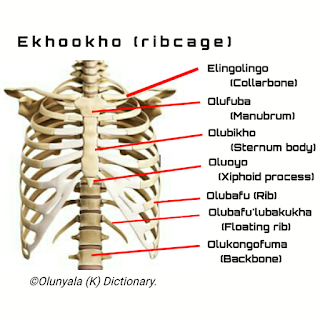
Abanyala ba Kakamega  have (had) indigenous knowledge of efficiently treating various degrees of bone fractures in animals and human using herbal medicine- without carrying out any body operation. A person who treats bones is called omuwamba (pl. abawamba) . The human bone specialists, abawamba , have names of various bones they interact with during treatment of animals and human. Also, those who are specialists in skinning animals, ababaaki , are good at identifying the various bones by their names.  Big human bones are called amakumba ( ekumba in singular) while smaller ones are called ebikumba ( esikumba in singular). Small thin bones such as those of fish and snake are called ebibakaya  ( olubakaya in singular ). The following are some of  the names that relate to bone. Bones in thoracic area of body Ekhookho - collection of bones that form the ribcage. Esirifu - all the front chest bones area. Olubafu - rib Olubafu'luakukha - floating rib. Olubikho - the bod...

ABANYALA BA KAKAMEGA: PRONOUNS 3- Personal Pronouns.

Image
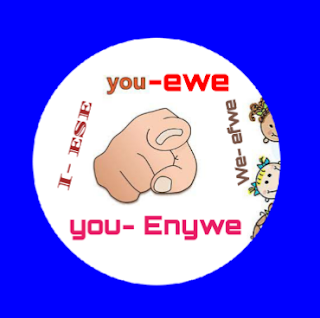
Personal pronouns are words used by the speakers to to refer to themselves, to whom they are speaking; or to people, place, object or ideas about whom they are speaking.  1. CATEGORIES OF PRONOUNS The main pronouns in Olunyala (K) are as hereunder: A] First person pronouns. Ese-  I/me . Ese  endi okhukhupa Okava I will beat Okava. Efwe- we/us Efwe  khuli okhukhupa Masika. We will beat Masika. B] Second person pronouns.  Ewe -  you  (singular) Ewe oli okhukhupa Maulo. You will beat Maulo. E nywe/emwe (nanywe) - you  (plural) Enywe muli okhukhupa Kirato Kirato ali okhukhupwa ni nanywe.   C] Third person pronouns. They form personal pronouns by using the third person prefix ni ~,  the noun concord prefix,  then the final vowel ~o . (i) They went with dogs. (ii) Ni b o bachia nende embwa . He/she/him/her-   exist in different forms based on the different singular and plural of human-noun classes. Niye. Pronoun us...

ABANYALA BA KAKAMEGA: PRONOUNS 2- EMPHATIC PRONOUNS

Image
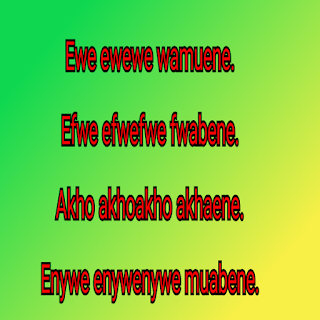
A] What are emphatic pronouns? Emphatic pronouns are pronouns that are used to show emphasis. They are also called intensive pronouns. For example:  Witches themselves bewitched dogs. Ab alosi abachana baloka embwa. Abalosi abaenebaene baloka embwa. In the above sentence, themselves in sentence (a) is an emphatic pronoun. In the Olunyala (K) translation of sentence (1) the word abachana is an emphatic pronoun. In the Olunyala (K) translation (2), abeenebene is a synonymous emphatic pronoun.  Emphatic pronouns are articulated with word stress than the neibouring words to bring out the emphasis. B] Which is the position of emphatic pronouns? They are usually placed after the noun or pronoun they intensify or emphasise. However, they can precede the noun for stronger emphasis.  i)      Efwe efwefwe sikhulianga emondo. ii)      Efwefwe efwe sikhulianga emondo In sentence (i), the emphatic pronoun efwefwe comes after the pronoun efwe....

ABANYALA BA KAKAMEGA: Pronouns 1- Reflexive Pronouns.

Image
REFLEXIVE PRONOUNS IN OLUNYALA (K) Reflexive pronouns are pronouns that refer back to the person or the thing named in the subject. They refer to the antecedent. For example:  (a) Witches bewitched themselves . (i) Abalosi beloka abaene . (ii) Abalosi ba e loka . In the above sentences, themselves in sentence (a) is a reflexive pronoun- the doer of the action is the recipient of the same action. In the Olunyala (K) translation of sentence (i), abeene is a reflexive pronoun. In the Olunyala translation (ii), the verb ba e loka has a reflexive pronoun marker ~ e ~. Due to tone use on the RPM, the vowel before it is less realised making it to be released as [b'é:lòká] Olunyala (K) can be said to have two known ways of forming reflexive pronouns: Reflexive pronouns formed from the root pronoun  ~ene   Reflexive pronouns formed by use of Reflexive Pronoun Marker (RPM) ~ e ~ a) Reflexive pronouns formed from the Reflexive Pronoun Root ~ene. The Reflexive Pronoun Root (RPR) ~...

ABANYALA BA KAKAMEGA: Language- Compound Nouns in Olunyala (K)

Image
By Balovera Edwin Ongacho Compound nouns are names formed by joining two words to form one word. In mostfact compound words of Olunyala (K), the two words are joined after deletion of the initial vowel in the second word. Thus, it is proposed that compound nouns be written with an omissive apostrophe between the words and not a hyphene as done in English.  The following is a list of compound nouns in Olunyala (K) or Olunyala East.  Akhalera'bana (akhalera + abana)-  a small type of caterpillar Akhamocha'lukongo (akhamocha + Olukongo)- motorcycle Akhasindusa'balimi (akhasindusa + abalimi)- the lizards with a long body. Akhasolola'mache- type of plant Amache k'enjukha- froth produced by spittlebug insect after sucking plant sap. Amakanda k'owang'i- plant with small fruits with black and white seeds in a red pod. Amakona'nje- types of air potatoes that. are poisonous if not cooked well. Amala'malulu (amala + amalulu)- jealousy. Amala'matiri (amala...

ABANYALA BA KAKAMEGA: Gender linked words

Image
By Balovera Edwin Ongacho Olunyala (K), also called Olunyala East, has words which are gender linked. The following are some of them.  Ekhole - he- goat  Elaho_ castrated goat emiku - ram Emosoti - heifer Eseyeyi - a male dog. Esibinje - a hut build for a mature lady who is unmarried. Esichiri - eunuch. Esichola - the first son one sires from an inherited woman. Esichong'o - unbetrothed lady Esichwisi - betrothed lady. Esimba - a female lion. Esimba - a hut belonging to young boys after graduation from circumcision. Esiombo - beautiful lady. Esipepe - brown ladies who were believed to be immoral. Esipichu - a lady of marriageable age. Esisonga - cow that has not given birth. Esitakho - hen that has laid eggs before. Esitwasi - female cow that has given birth. Esubeni - cockerel Esurusi - mature bull for bull fighting or mating. Etalang'i - a male lion Etaywa - cock Ewukuka - the clan into which your father is uncled. Ewukukhu - the clan into which your mother is uncled. Ewunw...

ABANYALA BA KAKAMEGA: Language- Naming of smells.

Image
By Balovera Edwin Ongacho Olunyala (K) has names for different smells. The following are the names. Ekhe - smell from aquatic vertebrates such as fish.  Engekhene-  smell of rust especially when in liquid or viscous form..  Embiye - bad belch smell. Emisu - smell from unwashed hands and utencils after eating a meal such as meat, chicken and fish. Epundi - smell from human urine. Esinokho - after s3x smell. Esinyololo - smell from urine of domestic animal. Esiobe - bad smell from nose mucus.  Eteko - dead human's smell. Olubululu - smell of frying fat. Oluchaai - the smell of exposed blood from human or animals. Oluchulilisi - smell from a fart. Olufube - smell of rotten eggs.  Olufundu - decomposing smell of item that is covered for some days. Olufululu - aroma of roasting meat. Olukakha - smell of wound or scabies on body. Olukekhi-  smell of a mongoose Olukhenenu - vaginal smell. Olukhole - the smell of a he-goat.  Olukukhulu - smelling mouldy  ...